Speaker:Professor Han Xiaoyi (Xiamen University)
Host: Assistant Professor Xie Cong (China Institute for Economic Research, Liaoning University)
Distinguished Guest: Professor Ma Xiangjun (China Institute for Economic Research, Liaoning University)
Time: 15:30–17:00 (Beijing Time), Thursday, May 7, 2026
Venue:Room 547, Faculty of Economics Building, Puhe Campus, Liaoning University
Online Access: Tencent Meeting ID: 690-510-966
Language: Chinese / English
Abstract:
In spatial and network panel data, time-varying (TV) dominant units exert disproportionate influence, invalidating standard estimation and inference methods. We study the generalized method of moments (GMM) estimation of a high-order spatial dynamic panel data (SDPD) model that features dominant units and unknown cross-sectional heteroskedasticity. We propose a novel classification of spatial weight matrices featuring dominant units and develop new general central limit theorems (CLTs) for linear-quadratic forms involving such matrices. We show that the GMM estimator (GMME) converges at a rate slower than the standard rate when the moment conditions include special matrices with dominant units that have unbounded row and column sums. To achieve efficient estimation, we propose a best GMME (BGMME) and a sequential root estimator (RTE). The RTE yields a closed-form solution, completely bypassing complex numerical optimization while preserving the asymptotic efficiency of the BGMME. We establish the consistency and asymptotic normality of these estimators. Monte Carlo simulations demonstrate that the proposed estimators have satisfactory finite sample performance, and the RTE has computational advantages over the BGMME. An empirical application examining the network peer effects of capital structure among Chinese listed firms illustrates the merits of our models and estimation methods.
Speaker Profile:
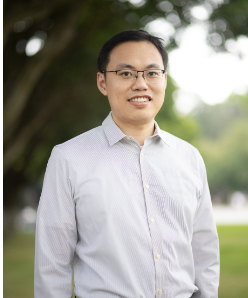
Han Xiaoyi received his Ph.D. in Economics from The Ohio State University in 2014. He is currently the Deputy Director of the Key Laboratory of Econometrics (Xiamen University), Ministry of Education, and a Professor and Doctoral Supervisor in Economics at Xiamen University. He has been recognized as a National Young High-Level Talent. His primary research interests include econometrics, applied econometrics, regional economics, and labor economics. He has published numerous papers in leading domestic and international economics journals and has served as the Principal Investigator for several national and provincial research projects.

