Recently, the collaborative paper "The Influence Mechanism of Future Industry Emergence—Based on the Perspective of Ecosystem Co-evolution" co-authored by Professor Yu Miaojie, President of Liaoning University, and Associate Professor Xu Jin of the Business School of Liaoning University, has been officially accepted by *Beijing Social Sciences*.
Paper Introduction:
The derivative emergence of future industries exists in a constantly changing dynamic process of co-evolution, and the future industry ecosystem is characterized by distinct multi-level and complex features. However, the co-evolution influence mechanisms among interacting entities at different organizational levels within the future industry ecosystem remain unclear, the impact of cross-organizational collaboration on future industry emergence awaits in-depth exploration, and there is still considerable research space for the dynamic evolution of future industry ecosystems. There is an urgent need for a research framework that can effectively capture complex system elements and cross-organizational co-evolution. To this end, from the perspective of ecosystem co-evolution, this paper analyzes the influence mechanisms of symbiosis on industry emergence and diversity on ecosystems, as well as the research framework of ecosystem co-evolution, and summarizes the influence mechanisms of future industry emergence. Centering on the systemic innovation ecosystem effect, the impact of government and policy systems on industry emergence, and the advantages and application potential of patch dynamics theory, it outlines the analytical framework for future industry emergence. It emphasizes that the patch dynamics theoretical framework simultaneously captures the dynamic co-evolution of ecosystems across multiple different organizational levels, which helps to analyze the influence mechanisms of future industry emergence and provides insights for research on future industry ecosystems and complex system management. On this basis, it looks ahead to research directions including exploring future industry emergence from the perspective of ecosystem co-evolution and interdisciplinary approaches, the influence mechanisms of industry symbiosis and industry diversity on cross-organizational co-evolution, the mechanisms by which cross-organizational co-evolution drives future industry emergence, and the design of collaborative governance strategies and effective governance frameworks for achieving future industry emergence.
Journal Introduction:
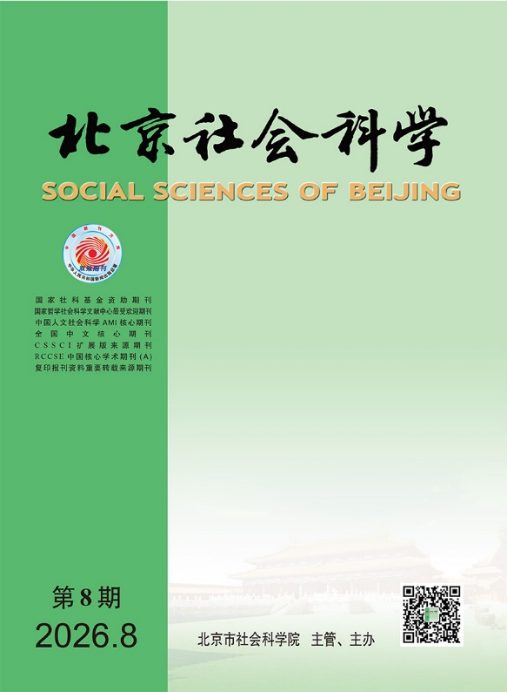
Beijing Social Sciences, founded in March 1986, is a comprehensive academic journal of philosophy and social sciences administered and sponsored by the Beijing Academy of Social Sciences. Its content covers various fields of humanities and social sciences, including literature, philosophy, history, economics, management, sociology, political science, law, education, and psychology. *Beijing Social Sciences* actively follows the latest developments in basic disciplinary research, focuses on exploring theoretical and practical issues in the new era, and publishes multidisciplinary and cross-disciplinary research achievements.
Beijing Social Sciences is a council member unit of the China Periodicals Association and is recognized as a "National Chinese Core Journal," a "CSSCI Source Journal," a "Chinese Humanities and Social Sciences Core Journal," an "RCCSE Chinese Core Academic Journal (A)," an "Important Reprint Source Journal of the Renmin University of China's Information Center for Social Sciences," and a "Reprint Source Journal of *Xinhua Wenzhai*." In 2012, it became a journal funded by the National Social Science Fund. *Beijing Social Sciences* was listed by the Beijing Municipal Bureau of Press and Publication as one of the five excellent recommended journals in Beijing among the annual national "Top 100 Academic Journals." In 2006, it won the "Beijing Excellent Publication Award," and in 2007 and 2008, it was consecutively rated as a "China Northern Excellent Journal" for the first and second sessions. In 2008, the editorial department of Beijing Social Sciences received the Advanced Collective Award of the Beijing Press and Publication Copyright Creative Achievement Award, and in 2009 and 2012, the editorial department received the Advanced Collective Award for Beijing Press, Publication, and Copyright Work. In the field of comprehensive humanities and social sciences, Beijing Social Sciences, with its relatively high readership, download volume, and popularity index, was selected as one of the "2025 Most Popular Chinese Journals in Comprehensive Humanities and Social Sciences," ranking among the top most popular journals in this discipline.
Authors Profile:

Yu Miaojie, President of Liaoning University, is a Fellow of the Royal Economic Society (FREcon), a Fellow of the International Economic Association (IEA), a Distinguished Professor of the Changjiang Scholars Program, a recipient of the National Science Fund for Distinguished Young Scholars, a Beijing Outstanding Young Scientist, and a Boya Distinguished Professor of Peking University. He serves as a deputy to the 14th National People's Congress, a special supervisor of the National Commission of Supervision, and an associate editor of the internationally leading economics journal Economic Journal. He is among the top 1% most highly cited economists in the world in economics and management, and is the only Chinese scholar to have received the "Royal Economic Society Prize" to date. He is the editor-in-chief of China's Open Economy, a key textbook of original Chinese philosophy and social sciences, and enjoys special government allowances from the State Council.

Xu Jin is a Young Talent of a Liaoning provincial talent program, an Associate Professor and Master's supervisor at the Business School of Liaoning University. His research areas include industrial ecosystems, population ecology, innovation management, and platform economy. His academic achievements have been published in academic journals such as Technovation, Nature sub-journals, International Review of Economics & Finance, and Science Research Management. He is a member of the European Group for Organizational Studies (EGOS), a member of the European Academy of Management (EURAM) and a reviewer for its annual conference, and a member of the Institute for Operations Research and the Management Sciences (INFORMS). He serves as a reviewer for journals such as Technovation and Nature sub-journals. His research has been invited for presentation multiple times at academic conferences including the EGOS Annual Conference, the EURAM Annual Conference, and the INFORMS International Conference. He is currently the principal investigator of four ongoing projects, including a National Natural Science Foundation of China project, a Liaoning Provincial Department of Education Science and Technology Innovation Team Project (Young and Middle-aged Talent Team Cultivation Project), a Liaoning Provincial Science and Technology Plan Joint Program Natural Science Foundation project, and a Liaoning Provincial Social Science Planning Fund project.

